Bridging Communities – History’s Lessons on the Need for Modern “Bridges”

Throughout the World, Maine is known for two things, lobsters and the rugged coast they are fished from… and maybe eerie towns full of vampires, but that’s mostly just fiction. For hundreds of years, millions of visitors have spent hot summer days basking on Maine’s nearly 3500 miles of beautiful and largely untamed coastline. While numerous communities such as Harpswell, Bar Harbor, or Camden have proven to be hard to access and costly to develop, despite this, these areas have become established and seen significant growth in the past years as many have decided to make this unique state their home. The costs of developing these areas are often overlooked by those that live there today, though they are impossible to dismiss in a historical aspect. Without the bridges and massive public initiatives that fostered their construction, these communities would have had a much more difficult time connecting with the larger economy of mainland Maine, perhaps staying isolated as many rural areas of Downeast and Northern Maine continue to be today.

Over nearly a hundred years of State, Federal, and Private investment, thousands of miles of state roads were constructed to help protect local industry and provide for the health of the citizens that call these communities home. These include highways, bridges, carriage roads, and other unique ways of investing in the stability of Maine’s transportation infrastructure. Without this, these same communities that thrive today with low tax rates and high property values would never have existed, stressing the importance that local investment has in helping to foster community development.

To highlight just how vital local investment, and specifically the public role, is in community development, I would like to highlight one community, in particular, Harpswell. This small fishing village turned retirement community has experienced tremendous property value appreciation and private wealth accumulation on the backbone of some historic public initiatives. These include both the construction of the one-of-a-kind Cribstone Bridge, connecting Bailey Island with her sister to the north, Orrs Island, as well as the construction of the Ewing Narrows, Mountain Road Bridge which connects the islands of Harpswell with Harpswell Neck, the neighboring peninsula. Both of these initiatives demonstrate the role that public enterprise has in directing investment, as well as the benefit that these types of projects have for these communities.

To start, let’s talk about the “boring” bridge. The Ewing Narrows Bridge, which opened to traffic in 1975, was a historic initiative by local citizens to connect two sides of the same town. Harpswell, shaped like a giant H, consists of the Harpswell Islands to the East and the Harpswell Peninsula to the West, connected to Brunswick by Routes 24 and 123, respectively. Before the fifties and sixties, many citizens would travel to the other side of town using the Middle Bay Road in Brunswick. However, with the expansion of the Brunswick Navy Air Station runways, the use of this road and another new road that was to connect 24 with 123 were closed. After an initial inquiry by local committees to see if the Navy for Federal Government would pay for bridge development proved fruitless, the first attempt at separation was made. A recurring theme throughout this post will be this pushback from residents towards local development, or specifically the funding of it.

After this initial failure at bridging the divide, the town continued to live separated. The only means of connecting to their families on the other side was to travel by boat or commute the thirty minutes to mainland Brunswick to travel another thirty minutes back down to the Harpswell Peninsula. This led to growing divisions in local attitudes towards the Harpswell Community as a whole and vastly different economic and social environments on either side. With the expansion of the islands, the need to add an addition to the newly developed Great Island school caused another controversy between residents. Even though the need was evident and the continually slowing enrollment in West Harpswell predicted its inevitable closure in 2010, many residents on the Peninsula felt that the town was unfairly investing in the islands and leaving them behind. This sentiment spurred the second vote to divide, though once again, the residents of Harpswell central voted to retain the current structure. However, as the hero of our story, Malcolm “Laddie” Whidden, pointed out this left half the town refusing to talk with the other half.

As tensions continued to rise, a small contingency of residents felt impassioned to make a change. Henry Barnes and Ned Frost reached out to Harpswell Neck resident Laddie Whidden with a pre-filled out selectman nomination form and a mission to bridge the growing divide. After winning the election in 1962, Laddie began a tireless campaign to both develop the land that would in the future become Mountain Road but also develop a plan with state and federal programs to help finance the construction of the Ewing Narrows Bridge. In 1966 the town voted to begin setting aside a “sinking fund” to build the Mountain Road. Using locally raised funds and eminent domain, the city started the construction of the Mountain Road from Route 24 to Long Reach Sound.

After completing the Mountain Road, the town, spearheaded by Laddie Whidden, began exploring state and county programs to help finance the construction of the bridge. In 1971 the One Hundred and Fifth Legislature, through the Joint Bridge Act, approved an act to Authorize Cumberland County to raise money for a Bridge at Harpswell. Identified as the Bridge at Ewing Narrows, the county commissioners were authorized to raise a sum not exceeding $300,000. Using this, local funds, and State contributions, the bridge finally opened to bid in 1973 and was completed in 1975. Finally, uniting a community that had been divided for nearly two centuries.

Following this connection, the benefits for the town could be felt throughout. Not only did the town population increase from 2500 in 1970 to 3700 in 1980, but the ease of access also helped to develop business and increase locally generated funds. Using these, the Gurnet Bridge was rebuilt in 1982. The construction of a Municipal Building on the brand new Mountain Road finally formalized the municipality’s local services. It led to the expansion of the town dump on the same land acquired in the 1960s. This highlights how not just access to but the ease of access to local economies can spur development in previously hampered communities. The town as a whole benefited from the steadily increasing revenues, and local businesses began to sprout up as more visitors found their way to this previously sleepy area of Midcoast Maine.

Going back in history to the turn of the 1900’s we are met with a much more exciting tale of adventure and New England Ingenuity. Harpswell Islands consists of three interconnecting islands jutting their way into Casco Bay; Sebascodegan, Orrs, and Bailey Island, in that order. Historically a fishing community, the proximity to Portland (by boat) and local universities in Brunswick has always drawn numerous visitors to these rugged shores. However, before 1928 the only way for these visitors (let alone the residents) to travel to Bailey Island was by boat either from Portland or Orr’s Island to the north, but only during fair weather.

While efforts to construct a bridge were made by those that called Bailey Island their year-round home since the early 1700s, due to local interference and the lack of availability of state programs, the project was not approved until 1927. After 200 years of debate, the people of Bailey Island would finally be economically connected to the town they called home. The timing of this program was not a coincidence either.

Starting with Governor John Hill in 1901, the importance of a statewide, state-funded highway system was highlighted. With increasing automobile traffic and heightened pressure from expanding industries, it was clear the chaos of local management was failing to meet the demands of communities such as Bailey Island. To address this, numerous initiatives were created to jump-start development in Maine. This included a $15,000 appropriation of state funds to provide up to $100 for each town to use on their roads. Through this appropriation, 2.5 miles of road were constructed, and by 1903, with the program’s success, the funding had been raised to $40,000.

To keep this momentum going, the state created the Office of Highway Commissioner in 1905 and appointed Paul Sargent as the state’s first Commissioner of Highways. After the effective expansion of the State’s public roads, the need for a more consolidated initiative was once again highlighted, creating the State Highway Department in 1907. With increased capacity and responsibility, Commissioner Sargent publicly began advocating the development of the state’s highways and primary roadways to help encourage the future development of Maine’s tourist and summer resort industries. With this newfound purpose, the hopes of the Bailey Island residents and the spirits of the mainland residents both saw a turn for the better.

In 1912 the initiative to explore the bridge’s construction was once again brought up to the town. The Journal of Automobile Progress and Construction highlighted in its May issue that the plan would include a “timber bridge” that would cost $3,000, though this cost was raised to $25,000 at a later meeting. To expressly help this and other efforts to connect remote fishing communities with mainland economies, the 1915 Bridge Act was passed. This created state and county aid for bridges constructed on main thoroughfares. Providing a split cost between county and state, many projects that had been previously stalled, such as the Bailey Island Bridge, saw new signs of life. This would, however prove not quite enough.

With a portion of the town’s population still seeing little benefit in connecting the few that chose to live on Bailey Island to the rest of them, especially when still looking at having to raise local funds, the plan to construct a bridge was once again stalled. Thankfully in 1927, due to the increased success of bond sales and lightened community settlement, the bridge’s construction was approved.

Chosen to build the bridge was Maine’s first state bridge engineer, Llewellyn Edwards. Serving as the bridge engineer from 1921-1928, his career had prepared him to take on this unique and still controversial challenge. I could spend a whole post discussing this man’s extraordinary impact on our modern economy, though this is for another time. Having previously designed several bridges in Canada and throughout New England, Edwards understood the numerous issues of tide and rocky outcrops that made the 2000ft span uniquely challenging to gap. After a commission survey was done and these issues highlighted, Edwards understood that a traditional bridge of solid fill would be unsustainable in these harsh conditions. Edwards, however, had a plan.

Creating a true one-of-a-kind bridge, Edward crafted plans to construct a bridge supported by a cribwork of thousands of individual granite slabs. These stones would be harvested from local quarries and would rest like a jenga tower on the harsh ledge. Being heavy enough to withstand the biting wind and waves, the worry of erosion was taken care of. The open cribbing would allow the free movement of water, preventing the appreciation of the average currents. Finally, in 1928 the bridge’s construction was completed for only $139,000.

Now in our modern era, Bailey Island sits proudly as a significant economic hub within MidCoast Maine. Boasting two restaurants, a general store, three gift shops, and a ferry service connecting it and the sister island of Orrs to thousand of visitors every year, no one would deny its significance to Harpswell’s economic health. As one local Realtor likes to say, “Every bridge adds $20,000 in value,” highlighting the incredible demand that exists for that once lonely little island on the end. None of this is possible without the empowered local organizing and massive public initiatives that finally connected it with the mainland.

Building off the success of these two historical initiatives, it is unsurprising to see how public debate has started to shift to one of our modern missing bridges, access to broadband, and reliable cellphone service. Much like the community of Bailey Island in the past, technologically isolated communities are stunted by little private investment, further exacerbated by their inability to access essential utilities. A Bill put forward explicitly looking to address this issue by one US Senator, Angus King, was appropriately titled the BRIDGE Act to highlight this problem. While we will have to wait to see just how much or if this Bill will pass, we must understand the historical significance of these types of initiatives if we ever wish to know the kind of growth we did in the past. There is plenty of untapped economic development that needs a way to bridge whatever issue is holding it back significantly; it’s up to the state and local partnerships to create the environment where they can finally do so.
Optimis(ation) Prime – The Consequences of Over-Efficient Markets

What value or service a business creates and the significance of markets has varied dramatically throughout human history. From local stakeholders to foreign ownership and providing a service to making a profit, business has had such a diverse history that many faces would be unrecognizable to our modern shareholder-lead economy. While there are many reasons for this, it is hard to deny the effect that technology and the ability to process information has had on the modern trend of maximization. From the rise of econometric models to the ever-changing climate forecasts, knowledge has allowed us to view our world in a way previously unachievable.

The effects of this trend are felt in every sector, from the more sparsely staffed and furnished Starbucks to the more tightly packed and analytically built shipping containers. These changes have effectively saved money or increased profits, fueling the massive increases in global GDP that we have seen over the past century. However, what this system optimization means for the larger economy has garnered little to no debate. It’s hard to convince someone with more dollars in their pocket at the end of the day that the change they made to get those dollars is damaging much more than their benefit. Because of this, we have started to feel the consequences of over-optimization.

One of the major issues to arise from the COVID Crisis, the drastic impacts to the supply chains and supporting systems, highlights exactly how this “optimization” can lead to harsh societal consequences when the goal is to increase profits rather than improve the service provided. Because the industry has created a system built around moving the most profitable amount of product rather than the most significant demand for development, in scenarios that vary significantly from the regular business cycle, the system proves to be unable to operate efficiently in any sense of the word. This can be seen in the alarming number of ships stuck at the port and the ever-increasing cost of reserving space on these same “more efficient” vessels.

While it’s not hard to see how turning an economy (let alone the globe) on and off again could cause some unforeseen ripples throughout the industry. It cannot be denied that for those that watch the shipping industry and its impact on consumer prices, the consequences could be seen from even before the shutdown. With optimization being the bread and butter of the business, shipping had decided on not only more optimized infrastructure but also hiring systems that allowed for larger workforces during peak seasons and smaller labor bills in the less profitable ones.

Because of this optimization, when the Pandemic first started to creep into the news, many businesses began to plan for tight supply chains and rising material costs. In doing so, significant industries worldwide saw orders rise to unprecedented levels, and in response, shipping began to amp up to accommodate these out-of-season demands. After this initial surge in purchases, much of the business saw a slow down in orders. They had already purchased enough to last through what was seen as a three-month shutdown, and therefore shipping slowed down. Because of this shift towards “profit retention” rather than investment, when markets began to reopen at a faster pace than those in charge had planned for, our world collapsed.

With this collapse came drastic consequences not just for the businesses that had manufactured this crisis but also for the consumers that relied on this chain to sustain their quality of life. Not only did shelves go empty (think the toilet paper crisis or mask shortage at the beginning of the pandemic), but slowly and surely, the hardships rippled into other areas of our life. As it became increasingly expensive to operate and ship oil worldwide, energy prices saw a historic rise, drastically reversing a decade’s decline. The hardships could also be felt in the overheating housing industry here in the US. As more people sold their homes in cities in favor of remote work in less populated areas, builders became stretched thin, adding to existing house price inflation while also limiting the market’s ability to correct.

The reason for this slowed “return to normal,” and colossal consumer consequences are partly due to many in business diverting emergency aid, not to reinvestment, but instead using these public funds to ensure that profits stayed high; which, arguably, is a shareholder based economy is the role of business management. The consequences of this are that much of the labor force and infrastructure have suffered lags as the world has turned back on. The previously mentioned ports suffering from massive delays are just the tip of the iceberg. Both the manufacturing and service sectors have also seen an uptick in quits strikes. Even Zillow had to shut down and reevaluate its Zillow Offers program earlier this month due to a considerable backlog in homes.

To see a change in how this business optimization is carried out, you only need to look at companies such as Revision Energy or Hy-Vee supermarkets. Employee-owned models offer a different outlook on what is efficient in a business model. This is because the benefits of business are not retained by shareholders that may or may not actively participate in a firm but instead shift the rewards of innovative business practice to those that develop and grow along with them. Through this model, companies see greater retention of talent, more sustained growth, access to increased benefit systems, and increased profit sharing to ensure equitable development. These are the same benefits I highlighted in the previous post on Public Utilities and their importance to the community.

By changing how the benefits of increasing production capacity are utilized to develop business practice, we can not only create a more equitable society but a more productive one as well. As highlighted in a 2017 piece by the Economic Policy Institute, these rising rates of inequality have cost the nation as a whole 2-4% of aggregate demand GDP just in recent years. By changing how companies such as John Deere and other manufacturers share the benefits of actual efficiency gains (not increased profit but long-term business development), not only will the workers see an increase in their quality of life, but the manufacturers and service sectors would see a broader customer base to draw from. While it may not be immediate profit, the more people can invest their incomes in their personal growth, the more our nation as a whole will grow; if we continue to focus on driving the benefits of our ever more “efficient” markets into the hands of capital holders, we will continue to deprive ourselves of not only higher incomes for all, but also a smaller social safety net and scope of government. For the betterment of our nation and people as a whole, a shift in business values is the only option if we wish to solve the major issues of the 21st Century.

Maine’s Trashier Side – Golden Opportunities in Dirty Markets

For many, where that cup ends after the sanitation worker takes it away is hardly a concern compared to life’s many trials and tribulations. However, for those that work in Maine’s processing facilities, it’s a way of life. With well over 1.5 million tons of waste generated and managed each year, it can prove a lucrative one at that. However, as highlighted in the Maine DEP – 2018 & 2019 Municipal Solid Waste & Disposal Capacity report, the entire industry and those that make a living from it are at risk. With the total amount of waste produced growing every year and several municipal landfills reaching capacity, careful cooperation is needed to navigate the issue. While the amount of waste being produced could pose as new revenue for private facilities, with the value of recycling materials on the commodities market declining, Maine will continue to see the amount and cost/ton rise, leading to increased cost, lower private investment, and the need for local taxes to be raised to subsidize the industry.

To highlight how severe this increase has been, from 2017 to 2019, Maine’s population increased by 0.4% while waste generation increased by 2.5%. During this same period, Maine saw a decrease in the Municipal Solid Waste Recycling Rate from 38.09% to 37.81% (2018 was 35.10% with an increase in 2019, no available data for 2020 though we can only imagine with the world it’s been). While a third of MSW being recycled may sound promising, it is in stark contrast with the 2.3% of Commercial Waste, where the rate is at 2.3%, highlighting the increased costs of more complicated waste such as metals and demolition debris.

With the private markets proving unwilling or unable to step in, the state has made several efforts to alleviate stresses on the industry. For instance, 38 MRS 1305 requires each municipality to provide waste disposal services for domestic and commercial solid waste generated within that municipality. This, however, causes the negative externality of forcing higher property taxes to support areas with higher waste generation. This extra cost is imposed most heavily on regions in a state of development with a high job and housing opportunities. To keep this burden on the public to a minimum, the municipalities will often cut out the more expensive costs imposed by recycling rather than landfilling.

To alleviate this issue, Maine put in place 38 MRS 2132, which imposed a state waste disposal reduction goal. This goal was to create a reduction in the amount of waste being processed by landfilling facilities to 0.55tons/capita by 2019 and to further reduce the statewide per capita disposal by an additional 5% every five years after that. This, unfortunately, has not been met. Maine statewide per capita tonnage increased from 0.54tons/capita in 2017 to 0.63tons/capita in 2019. With the massive spike in online shopping, the state is destined to see this number increase, especially after a year such as the last one.

Noting the failure to meet their previously constructed goals, Maine looked to see where this strain was on the system was developing from so rapidly. Recognizing how the low domestic production creates increased imports into the state, Maine implemented a bill in 2021 that requires manufacturers instead of citizens to bear these inflated costs. To accomplish this, this bill works by charging producers that import into the state a fee based on many factors representing pertinent externalities, most notably the tonnage of packaging they subject on the market. This program mimics those seen in the EU and other areas of the world, all of which have been a resounding success, effectively increasing recycling rates and cementing the resilience of their collection programs. Though, of course, we will have to wait for time to tell with Maine’s newly passed bill.

While increased regulation can prove effective, there is, however, another way. Developed over the last century by several economists, chemists, engineers, architects, and many more, the Circular Economy has continued to gain following over the past two decades. This theory denotes an economy that is restorative and regenerative in design rather than the linear form they take today. The process goes beyond regulation to evaluating the way we do business and understanding the impacts it has on the world around us. As has been established, our increased dependence on single-use products creates exorbitant waste imposing higher costs, as well as many health and safety risks to the public.

By adopting an economy focused on long-term efficiency, many economists believe that we will not only lead to more sustainable markets but also a more profitable future. As pointed out by the Ellen McArthur Foundation, not only would the combination of increased revenues from emerging circular activities help generate higher GDP, but lower costs of production would also arise thanks to the more efficient utilization of inputs. The effects of this dual pressure would be felt throughout the economy as supply, demand, and prices all reacted to the new and more optimal use of markets.

To highlight how this effect can arise, one can look at products such as mobile phones or washing machines. These products are considered medium-lives, meaning you will have to replace them every 3-5 years. By improving the long-term efficiency of these products (both through more efficient design and easier access to repair rather than replace services), it is estimated that the EU could save an annual net-material cost of $630Billion. For even faster-moving goods, such as cleaning products, the savings could reach $700Billion globally. These savings arise not only on the producers’ side through more efficient inputs but also in the consumers’ wallets through lower product prices and a minor municipal need to manage the ever-growing mountains of trash.

Another critical aspect of the Circular Economy is its employment benefits, especially in areas where the less efficient markets have left gaps still yet to be filled (think of the coal belt or Mill Towns in Maine). Not only would reducing generated waste lead to more efficient markets and higher pay, but the opening of new recycling/retaining services, as well as improved cost efficiency, would lead to higher overall employment nationwide. These jobs include retail as the quick linear model we have is modified to a more customer-friendly and attentive one, as well as higher-skilled jobs in the new remanufacturing markets and a stimulated entrepreneurial market.

This leads to another important concept that many prominent economists have been highlighting in the past decade. Throughout our history, markets have proven time and time again that they are the most efficient way to organize the use of goods and services. However, the strength of these markets has only been fully utilized when there is a mission that needs to be accomplished. As Marianna Mazzucato points out in her most recent book, “The Mission Economy,” the United States saw exponential growth during the ’60s as the nation rallied around the idea of landing on the moon. This brave new frontier represented not only the ambitions of humankind but foreign frontiers of brand new opportunities. Utilizing massive public organizational capabilities with private innovation, not only did we accomplish this goal but also achieved a higher quality of life as the preliminary technologies found new uses in everyday items.

In our modern-day and age, there are plenty of new challenges that represent the opportunity for an Apollo sized mission. The Circular Economy just so happens to be perfectly suited to address the most pressing of our time, climate change. In the same study that highlighted the impact on employment, adopting a Circular Economy for the 10 OECD countries could represent a 70% decrease in carbon emissions. This would be a huge step forward as the world fails to meet the goals set in global treaties such as the Paris Climate Accord. By uniting under the umbrella of fighting climate change, not only can we save our world, but we can also help to create one that is more equitable and healthy for all to live in. Less waste means fewer pollutants, more efficient systems mean no need to endure overbearing replacement costs. New technologies will offer improvements just as the Apollo mission led to memory foam and even artificial limbs.

The movement towards a Circular economy can already be felt throughout the world. Both public efforts such as expanded recycling services and a shift towards renewable energy are complemented by groups such as the Ellen McArthur Foundation and the Plastic Makers of America in developing these models without much citizen influence. However, to make the needed changes before it proves too late to accomplish our generational mission, we as a people must invest in encouraging the change. This includes both votings for leaders that share these values, as well as using our wallets to influence private markets. By supporting businesses that donate or purchase services from organizations such as those named before, we can hasten the adoption of this new, more efficient model.

We in Maine have our role to play. As our waste issues continue to grow and more people continue to move here with the adoption of remote work, our entire economy will continue to be strained. However, because of this ever-increasing domestic demand, we also find ourselves unique to help other areas meet these goals. By expanding our domestic recycling capacity through both public management and incentives to private processors, we can not only help close by partners such as New Hampshire in meeting their own waste reduction goals but present expanded professional job opportunities to those in our state. This will be incredibly important as we see existing higher-paying markets be exposed to increased competition without state competitors.

New Hampshire’s B.E.T on Business

Taxes, taxes, and taxes. That seems to be what’s on everyone’s mind lately. From AOC’s provocative dress to Biden’s budget, taxes dominate our social and political debate. For many, it’s a concern of who is “pulling their weight” in society; for other’s it’s theft; for (most) economists, it’s a way for the government to balance the money supply. No matter how you view them or if you like them, there is no getting away from the debate.

Here in Maine, we have been wrestling with ambitious initiatives looking to create new social programs by taxing the state’s (few) high-income earners. While I do inherently agree that if we are going to rely on an income tax we should be looking at creating a system that does not put unneeded stress on those that need income the most, it is important to highlight that this isn’t the only option. In fact, just across the border we are presented with a unique tax structure, many argue works more efficiently then our own.

New Hampshire is famous for its motto, “live free or die.” Taking this to heart, the state imposes no income or sales tax. There is a 5% tax on dividends and interest, though this is arguably a tax on rents, not income. This policy is beneficial for many reasons, and the windfalls are seen in multiple sectors.

For starters, New Hampshire boasts an average income of roughly $76,000 to Maine’s $56,000. There are undoubtedly numerous socio-economic reasons for this divide. However, it cannot be ignored that the absence of a sales/income tax offers the low-income earners a further-reaching dollar than their Maine counterparts. This, in turn, can help to spur domestic demand through spending, encouraging new businesses to move in as the services are expanded, raising property values, and stimulating growth through public and private investment. The same dynamic leads to citizens from other states crossing the border to purchase products tax-free, only to take them back home to consume there, highlighted beautifully by the New Hampshire Liquor store just a stone’s throw from their border with Maine.

Looking at these numbers, it could be argued that New Hampshire is missing out on a significant revenue source, limiting its ability to grow. This, however, is quickly dismissed when you compare budgets. New Hampshire’s is slightly smaller at roughly $6.5Billion to Maine’s $8Billion, translating to $4,400/capita and $6,000/capita, respectively. With only a difference of $1.5Billion, the fact that Maine’s dependency score (based on a ratio of dollars received and sent to the federal government) is more than double of New Hampshire’s highlights how the increased private investment both allows for smaller local government, well also diminishing the footprint it leaves on the federal budget by prompting additional tax growth. Finally, comparing the GDP of the two states highlights how the competitiveness of the tax code can impact the quality of life for its citizens. With almost four times the total square mileage, Maine’s GDP comes in ten billion lower than New Hampshire’s, $67.7Billion and $76.6Billion, respectively.

So if Maine has every advantage and is still falling behind, what can we do to be more like the snappy little state to our West? I’d argue for the same vein of policy as the former Presidential Candidate Andrew Yang, tax the dollars before they hit people’s wallets. In doing so we can impose a smaller burden on our citizens while also creating an easily enforceable tax code as people’s working and social lives continue to diverge with the onset of remote work. To do this, we could impose a VAT tax on manufacturing business or even mimic New Hampshire Business Enterprise Tax system, ensuring that businesses are paying for their fair share of development rather than using capital gains schemes to swindle their way out of taxes.

The argument can also be made to cut taxes as a whole and eliminate spending. This would work perfectly if taxes were the only thing determining when and where businesses set up shop. For starters, and as highlighted in my previous post on social mobility and community development, if there aren’t people, the businesses won’t invest. A healthy workforce is the primary concern of any new or developing company. As well, the ease of access is highlighted in the fiasco that was Amazon HQ2. By eliminating regulations, cutting taxes, and investing in infrastructure, the numerous municipalities all around the America’s highlighted what it is a business is looking for when choosing a new community to invest in. In order to promote these services, Maine will realistically have to spend to fix our roads, improve internet access, create a more mobile populace, protect businesses from climate change, etc. Because of this, we must remove from the table the notion of “small” government and instead focus on what the partnership of public and private is, a balancing act.

Maine has a long way to go to be considered competitive with the rest of New England. The shift to remote work during the COVID lockdowns helped to encourage new citizens to move here. To ensure that we reap the benefits of this in-migration, we must look to the states around us that have benefited for years. By creating a healthier, happier, and more equitable state, we will not only be increasing the GDP but improving the quality of life for those Maine families that had called this rugged little corner of the earth home since before it was Maine. To fail to do so will put us back into the cycle of dwindling young families and slowing business growth; to fail to do so is to fail Maine.

Education or Certification – Limitations to Maine’s Emerging Workforce

The debate over licensing is far from new. As many who have gone through a Business/Finance degree in college know, Milton Friedman and many other neoliberal economists highly disagree with modern licensing structures. In their view, they demonstrate inefficiencies in allocating resources (in this case, labor) and limit the actual output of an economy. Despite these pleas from economists and intellectuals, the rate of licensing in the US economy increased by four fold from 1950 to 2017. The consequences of this shift in certification over education can be felt throughout the nation.

The reason for this shift can be attributed to numerous sources. For starters, and as pointed out by authors such as Mariana Mazzucato and Stephany Kelton, lobbying by industry insiders is regularly used to create barriers to competition. While this often makes a source of protection for industry insiders, it also hinders the strength of free markets that neoliberal and monetarist economists argue for. The shift of the modern economy from a manufacturing to a service-based economy creates the environment for these programs to take hold. Many services, such as Real Estate Offices, Dental Practices, and Accountants, require specific licensing (and insurances) to start operating. For those with the knowledge to work/compete within these fields, often the hindering factor is where they’re coming from in life, both geographically and socially.

Here in the state of Maine, this issue is exacerbated not only for the two reasons stated in the previous paragraph but also due to our limited access to educational services and the wide variation in population distribution we see between the northern and southern portions. Because of this, we need to take a moment to see how three different programs have either enhanced or hindered industries in the state. From there, we will attempt to learn why these programs have “failed” and what we can do to foster a healthier system moving forward.

The first program, and arguably the most successful, is the often controversial career of Real Estate. While many feel that Real Estate agents are overpaid for the work they do, professionals such as these indeed invest not only their time but also their un-guaranteed income to foster their careers. To become a Sales Agent, a Maine resident must pay roughly $500 for a two-month course and pass a state-mandated test post-completion. To maintain their license, an agent will regularly spend up to $1,000 in fees per year, regardless of whether they make a sale that year or not.

While these limitations are not cheap, they require no prior education and offer employment in almost any county in the state (the limiting factor being existing competition). This has allowed for a proliferation of realtors within the state. According to the Maine Association of Realtors, there are currently 4,500 Realtors in the state, representing 600 firms. For a state with only a million citizens, that is huge. Representing nearly a billion dollars in volume and growing every year, this created a lucrative opportunity that most can quickly gain access to. The most significant hurdle these individuals must overcome is the geographic limitations that limit their ability to access the required certification programs. However, the increased access to internet services and adoption of online education has allowed for this limitation to be lifted in previously depressed markets such as the northern portions of our beautiful state. While this is an ongoing struggle, it highlights another reason why internet access is a utility that is required in modern life.

This relatively easy access to the field creates a separate but related issue. As more people gain access to these types of “low-hanging fruit,” the industries tend to become saturated, adding to the competition limitation holding back the median annual income of license holders. Even with the massive volume, most agents in the state average only a few thousand dollars a year in annual income, leading agents having to split their time between two jobs or even abandon the career in search of stable income. This is highlighted especially in markets along the coast where real estate is limited compared to the number of agents attempting to secure footing in the market. Due to this, many individuals that have grown up in these communities are forced to move to newer, less competitive, and less lucrative markets to sustain their careers. However, many still choose to abandon the journey altogether and search for different options outside the state. As these issues are exacerbated by a lack of similarly easy to access fields in the state, Maine continues to miss out on vast swaths of private development, as well as public revenues to help develop our domestic economy.

While the example of the Real Estate industry highlights the issues of a market being too easy to access, the second example highlights how the limited access to related fields exacerbates these types of problems.

The second program, Appraisal Services, is directly tied to the previous issue of competition and opportunity costs it presents across markets. While many states have sought to create a certain amount of “professionality” in their lucrative real estate/financing industries, that attitude creates a barrier holding back not only the potential income of those in the field but those fields directly tied to them.

In Maine, Appraisal Agents must pass a similar certification program as Real Estate Agents. After investing a few hundred dollars and passing a state-mandated exam, the only necessities for maintaining the license are paying your dues and attending the required continued education opportunities. The difference lies in who can access this program. While these barriers vary depending on which region of the US you are in, Maine requires individuals to hold at least an Associate Degree or 21 hours of education in required courses. For those that have similar geographical and service-based limitations, such as those discussed for Real Estate licensing, these issues are compounded by the financial investment one must make to complete an Associate Program.

This limitation has done two things for the appraisal industry in the state. Firstly, it has allowed numerous individuals to secure large swaths of a market that proves to be incredibly competitive on the other side of the coin. Secondly, it has limited the ability of the other side of the coin from effectively coming face side up, limiting the total actual output that the industry holds. To tie it into Maine’s most famous industry, lobstering. This problem could be compared to an industry where wharves and processing services retained current technology and efficiency well the lobstermen return to hauling individual traps by hand. Not only are the lobstermen missing out on income in that if they could catch more quickly, they would make more money, but as well, by limiting their capabilities, they are forcing the individuals who make their money processing their catch to lose out on potential income as well. This creates further problems as these secondary industries are forced to balance their labor force to optimize their services for existing rather than total potential output.

The final example hits home for many who have grown up in this unique and rugged land. Modern lobstering licensing programs incite a tremendous amount of controversy for those families that have been operating within the industry for generations. Without the ability to grandfather their license, as well as significant waits on the lists of people trying to obtain a permit, many of those in the younger generations are being forced to turn their sites away from their historic stomping grounds. This highlights how a licensing program intended to protect the livelihood of these individuals through effective stock management instead creates a system where these families are adversely affected and forced to remove themselves from local markets instead of living, working, and creating demand within these isolated communities.

One example of this is the town of Harpswell. For generations, and until the 1990s, many families in Harpswell made their income fishing and working along the rugged coast. Children would grow up swimming off of their family’s generational wharf, only to reach adulthood and launch from there to continue fishing the “hidden, hot spots” their fathers had only told them. However, and for many reasons, including a shifting demographic of who wanted to move to town, as these younger generations continued to see limited opportunity in local businesses and having their fall-back career of fishing being ripped away from them, they continued to search for opportunities elsewhere.

As this shift took hold, the consequences could be felt around town. With a lack of opportunity and sky-rocketing property values, many younger families looked elsewhere for where to establish themselves. Enrollment dropped between the towns two elementary schools that the programs were consolidated to just one school in 2011, chocking on almost 20 minutes to some families commutes due to the odd shape of the town. Services such as the local volunteer firefighters (the only FF’s in town) saw their enrollment drop and average age rise. This has led to fewer homes being saved from complete destruction, as well as the town beginning the effort of investigating the need for a public, centrally based agency.

This demonstrates how the intention of licensing can often be forgotten as the licensing programs are affected by lobbying over time. Not only does it create issues of increased barrier to entry and protection of established actors, but unintended consequences may also limit the ability of these established actors to continue to operate within their industries. As these individuals are removed and consolidation takes place, Monopoly power tends to increase. This, too, can be felt in the fishing industry as privately owned and captained boats are replaced by fleets and foreign ownership.

To protect the state from the numerous issues that licensing can present, the solution is relatively straightforward (and one of the few I can say I agree with neoliberals on), do away with the programs, and let the markets operate at their most efficient level.

While there are obvious cases where licensing should be put in place, the instances highlighted previously demonstrate that these arguments fail to apply to all industries uniformly. It is imperative to highlight both the industry limitations and the goal of the licensing programs to determine their efficacy.

For starters, programs such as Medical Professionals require a certain amount of education to ensure not only that the job is completed correctly but also that there is a certain level of trust between the service and those that are seeking out professionals in the field. The same can be said for why we have licensing programs for Real Estate Agents and Appraisal Agents. However, this highlights the importance of the purpose of the program is. If the intention is to ensure trust with the public, then the negative externality of limiting those that can access the career can be viewed as a positive when viewed as removing those “unfit” from obtaining the licensing. This outlook fails to acknowledge those that fail to complete the program due to no fault in character but instead in access. Because the issue of access is much more pertinent than the character of those seeking to license in our minimal state, the inefficiencies of this licensing program lead to losses in actual output. In acknowledgment of this, Maine must find a way to ensure that they recoup that loss. Opening up the ability of these license holders to offer services in the same capacity as similarly licensed individuals would allow for greater competition and broader areas of coverage for the more strained communities.

The same can be said for what is currently holding back Maine’s huge Real Estate industry. By opening up these industries to individuals, we will encourage competition, as well as domestic demand, as the lower-income populace finds more opportunity for social mobility. This case has been highlighted in the Lewiston-Auburn area over the past couple of decades. With easy access to Portland and other more developed economies, many saw an opportunity in the area. As more people began to move in, more Real Estate agencies set up shop, attracting appraisers and other legal services to the area. With the increased opportunity, more citizens of the two towns took advantage of these higher paying positions and moved from careers as day laborers and retail workers to agents, and other easier to access positions. Nowadays the largest hurdle is the lack of appraisers in the area, making real estate transactions slow and costly for those trying to establish in the area. By eliminating the education requirement we can help continue to foster the growth of these up and coming areas while also promoting the development of the surrounding communities as populations shift and new services are demanded.

As highlighted by the Maine State Economist’s office, we are currently presented with a rare opportunity. While birth rates continue to decline, in-migration continues to be on the rise. To help currently depressing communities best take advantage of these new, higher-paid families, opening up these mid-income careers to the existing populace will create a healthier and more sustainable economy for all. As highlighted in the previous post about the demand for services and how it affects municipality growth, migrating populations demand certain services in the areas they decide to move to. By limiting the existing population’s access to work in these fields, we deny ourselves the opportunity of those families settling in these up-and-coming areas. To protect private incomes and public revenue, we must once again shift our accreditation values to education rather than certification. Otherwise, we risk ruining this once-in-a-lifetime opportunity.

New Faces, Old Roads

Maine is one of the oldest states in the nation. This is a problem for many reasons. Older populations mean fewer workers and larger demographic dependency, straining the younger generations from being able to find their footing. As highlighted in the most recent population outlook, put out by the Maine State Economist in April of this year, there is, thankfully, a light at the end of this lonely tunnel. More people are “migrating” to the state of Maine than has been seen in the past 20+ years. With them, these young families bring a strong labor force, domestic investment opportunity through increased tax revenue, demand for low to mid-income positions, and many more positives to our slowly decaying economy. However, we face a new issue as their numbers increase. How do we convince them to stay?

For time in memorial, the ability to attract solid and working-age individuals to your “society” has been paramount to building a healthy civilization. To do this, leaders have diversified their tactics from tax breaks to public employment and even kidnapping. To this day, these same tactics are being used to entice those fleeing the “less desirable” states for those with more opportunity. This can be seen as many leave the North-West portion of the US to escape the tragic and deadly fires that plague the region in search of more “stable” environments. At the micro-level, this same issue fuels new business decisions, determining which regions/municipalities reap the benefits of this boom in population.

As someone who has lived and worked in the Brunswick/Topsham area for the past 20+ years, this battle has been evident in my everyday life. Throughout my life, I saw a fascinating shift in population, as well as new business development, leading to more robust local investment. The reasons for this trend are worth a blog post of their own, so instead, let’s focus on the broad stroke outcomes this leads to.

Starting in the 1980s and continuing into the early 2000s, for reasons such as tax benefits and local development, new businesses began to take foot in Topsham rather than the already crowded Brunswick. With a growing population, these businesses found a large workforce to fund their ventures, as well as new housing developments that offered a great equity sink for these young entrepreneurs. In light of this shift, local tax revenues began to increase, and investment was demanded in response. With many young families coming to start, work in, or commute to local positions the obvious number one need was an educational service to ensure these parents children were given the best and brightest education, and that they didn’t decide to settle in the next town over. The Mt. Ararat Middle School (a part of the larger MSAD #75) was constructed in 2001 in light of this new demand. As more new families continued to move into the area thanks to the Brunswick Naval Air Station, the government also began to develop more housing opportunities for those employed on the base and their families.

Then in 2005, the unspeakable happened, the Federal Government announced the closure of the Brunswick Naval Air Station. With the departure of hundreds of families and thousands of individuals, the future of this robust development came into question. Not only were we losing a significant source of local population growth (a part of the reason that the Brunswick area has amounted to such a hub of the population can be tied directly to BNAS, as well as the presence of local institutions such as Bowdoin College), many of these families teenage children stayed in the area after high school, helping to supply the growing demand for labor. With labor demand becoming strained and Real Estate no longer growing in equity, many local families began to debate whether they could retain the quality of life they had grown to enjoy during these ‘golden years. Something had to be done, and Brunswick proved to be the first to act.

Thanks to the acquisition of the significant new developmental center of the former BNAS, Commercial Real Estate once again become “cheap.” In light of this shift, local developers shifted their gaze from the sand dunes of Topsham to the pre-developed streets of Brunswick (to this day, large commercial plots sit vacant next to the Topsham Fair Mall, still listed on the market today). However, in light of the reality that many of those currently existing in the labor force had begun to move to the “up and coming” Topsham, the need for cheap housing was paramount in supplying these incredible opportunities. By repurposing many of the existing townhouses into rental units and developing new ones, the lower-mid income families once again found a home in Brunswick.

Today, the results are as clear as day. Boasting dozens of new businesses, hundreds of jobs, and tens of thousands of square feet in residential space, Brunswick Landing continues to operate as an economic driver in the area. When seeing how the shifts in business/human migration can so drastically affect the quality of life in these areas, the question of why one place wins over another becomes paramount to ensuring healthier and more robust communities in the future. As Maine continues to see an influx of new citizens, often coming from areas with previously developed services similar to Portland and Brunswick, how do we make areas that desperately need new citizens to encourage further development? The story of Lewiston-Auburn may help to shine some light in this area.

As Maine’s second and fifth largest cities, Lewiston and Auburn have shown what happens when businesses once again leave an area, though the people do not. For generations, and once again thanks to a river, the towns operated mills and other manufacturing services that supplied steady jobs to their populace. Being able to start at a young age, many families would see generations work through the same mills. In response to this planted and well paid population, other services began to move into the area. The remnants of this development can be seen in the numerous historical and gorgeous brick buildings that line the riverfront on both sides. However, as those manufacturing industries began to leave (similar to how they did in Brunswick/Topsham) the people left behind found few options that could pay them similarly to the former mills. As these individuals lost their buying power simultaneously with the Real Estate becoming less attractive to investors, many businesses started eying towns closer to the scenic Route 1, and so began another mass relocation closer to the coast.

However, they left something behind. Much like Topsham in the ’90s and early 2000s, the infrastructure developed during this time remained. From entire historic districts to expanded opportunities for new construction, the Real Estate of the LA area slept, waiting for the shift we see today. Now, as Real Estate once again becomes expensive in the Brunswick area (and towns like Topsham show little new opportunity), investors have begun to shift their sites to these previously forgotten treasures. However, this influx of private funds would never have come without a pre-existing population and easy opportunity for profits that sustains it. Therefore the following question in our chain of thought has to be asked. If we need both a healthy labor force and ample opportunity for private investment (i.e. profit), how do we achieve this balance in areas such as Orono or Old Town? These two towns are similar in many ways to Brunswick/Topsham but lack the fundamental difference that spurs this type of economic growth, a healthy private-public relationship that fosters the quality of life that convinces new families to stay.

As seen in the new schools, roadways, and local council involvement such as the Brunswick Downtown Association, these types of public service-focused investments foster the services that young families look for when deciding where to settle for their first home. By failing to encourage these systems, towns as diverse as Orono (inner college town) and Harpswell (coastal retirement community) deprive themselves of the sustained economic growth they are poised to take advantage of. This lack of investment can arise for many reasons. Whether its because the towns residents desire to keep their “cost of living” cheap by lowering taxes (ignore the costs of the numerous negative externalities this causes) or because there is a lack of a central order. No matter the reason, the answer to overcoming this issue is simple. Invest in yourselves and you will see growth, don’t and you’ll see yourselves fall behind.

One great way to overcome this problem is to look at how high school educated individuals may foster a healthy career in your town. For instance, wastewater management is an issue that is present no matter where you live. Many positions within these facilities do not require a college-level education, therefore allowing opportunities for young individuals to stay and grow in the area. The issue, though, is that these jobs are scarce. I can remember when I was at Orono around 2015 and had a professor explain to me about the up and coming opportunity in waste management (some higher-level positions require biology degrees to help understand the more intricate processes of the plants) as many of those in the labor force were nearing 60 and would be retiring close to my graduation date. While this did not excite me at the time, the impact of these positions is not wasted on my more economically focused mind.

To help create these types of jobs, the public sector has to step in. It would be hard to imagine a private actor going door to door asking to process your poop for a monthly cost; therefore, we should identify other areas where these types of “market failures” exist and use these opportunities to help create a healthier labor market for those most in need. In my mind, this could be local energy management to create energy independence for isolated communities, public planning boards to direct investment, development of public transportation to encourage easier migration to less developed regions, or even new public housing in similar models to what we’ve seen work privately for the Brunswick Landing. Through these and other hard investment projects in the state, we can help foster the movement of these individuals and businesses to encourage them to explore and settle in the areas that need them the most. By promoting local growth these investments will pay for themselves as long as the rate of tax revenue is above the annual interest rate. This means that as long as r-e<0 (which it most often is, as proven in numerous economic journals), the local investment will not only pay for itself but even turn a profit in many cases. By increasing in-migration you not only increase tax revenue from new labor, but also from the development costs of private investment and increased domestic demand driving up sales tax revenue. With these massive increases in public funds we can see this type of growth compound, that is as long as we continue to encourage this development well into the future. It’s those that ignore the needs of their populace that see the exodus of their citizens, we must avoid this at all costs if we wish to see this beautiful and unique state compete in the later parts of the 21st century.

Maine and Community – How to Create Resilient Energy for Unique Regions

Maine has always been a unique state. Its population is small and spread out over a swath of undeveloped land. From the remote fishing villages along Downeast Maine’s coast to the unorganized townships to the north, much of Maine is fueled by small micro-economies rather than the macroeconomy as a whole. There is one area in which we as Mainah’s share the load, though, the energy grid. My argument in today’s post highlights how our lack of community focus in this one field has allowed companies like Central Maine Power to take advantage of our citizens, as well as how it fueled Maine’s exorbitantly high electricity costs.

For starters, let’s discuss the Clean Energy Connect. For the past three years, Hydro-Quebec and CMP have petitioned the state’s legislators to push through a “clean energy corridor” to supply Massachusetts with hydro-power produced in Canada. When the project was initially proposed in 2018, Massachusetts selected the Northern Pass Project, presented by Eversource. This project would have had the line run 192 miles across New Hampshire and Massachusetts, with a 60-mile portion of the line to be buried to protect areas of the White Mountain National Forest. The final project proposed by CMP is for 145 miles and 53 miles of new cutting to develop a line from Beattie Township to a connection into the New England Electric grid in Lewiston. The costs of the development (~$950Million) are to be paid by Massachusetts.

When proposed, the Eversource deal offered New Hampshire $210 million in funds to help tourism, economic development, and habitat restoration projects. For comparison, the CMP deal offered to Maine (after negotiation from Governor Mills) $258 million in a similar package. While these may seem similar on their face, it is important to note that the additional funds to Maine are to be distributed over the next couple of decades. With Maine receiving it’s first round of payments amounting to a measly $5.8 million, this May, it’s clear that the the funds will need to be carefully managed as over such a long timeline allocation mistakes are bound to happen.

While the two deals are similar, it is this similarity that I feel points to the significant issues within our current energy grid. For starters, if CMP was able to meet the $200 million that Eversource offered initially, why was their first offer for just $50 million? The answer is simple; the deal is good at either number. Both of these companies could make Billions with these contracts, meaning that a couple hundred million is chump change for them. All while these funds mean serious business for these states. If there is this much profit to be made by business owners that aren’t even US citizens, why aren’t we trying to capitalize on this market ourselves?

There are many different ways we could do this. As an example, I’d point out the recent legislation put forth in the attempt to create a Consumer-Owned Utility for the state of Maine. While I am personally a fan of this proposal, it is not the leading solution I want to highlight with this post. For me, the most significant issue we face is an antiquated grid that was made for electricity production nearly a hundred years ago. Our current capabilities are leaps and bounds ahead of anything we have seen in the past, finally offering us the ability to alter an incredibly inefficient system. Especially when you start to look at states like Maine, does this need for a new energy grid start to become apparent. We are a spread-out state; as I stated at the beginning of the post, Maine’s population is often found in tiny micro-communities capable of sustaining themselves. This type of population distribution creates a problem that more developed states do not have to overcome; if everyone lives everywhere, it doesn’t matter where the energy is produced. There’s always a customer close by you can cheaply get it too. As well, just like the UK and teapots creating energy spikes in the afternoon, Maine experiences an incredibly seasonal amount of electricity demand, spiking with the population in the summer months.

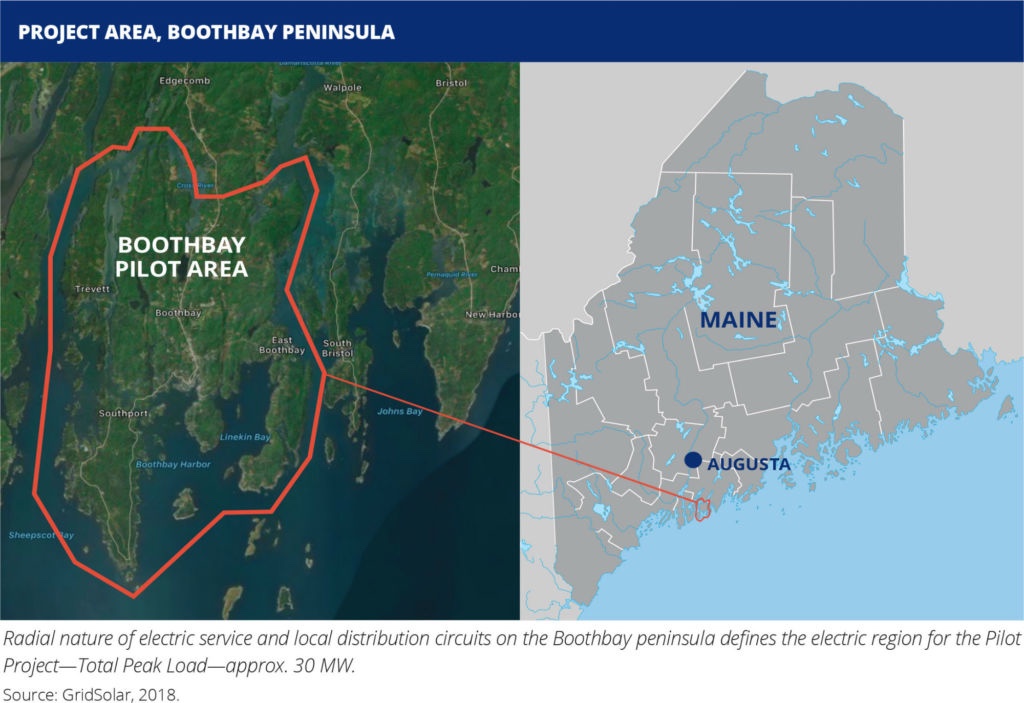
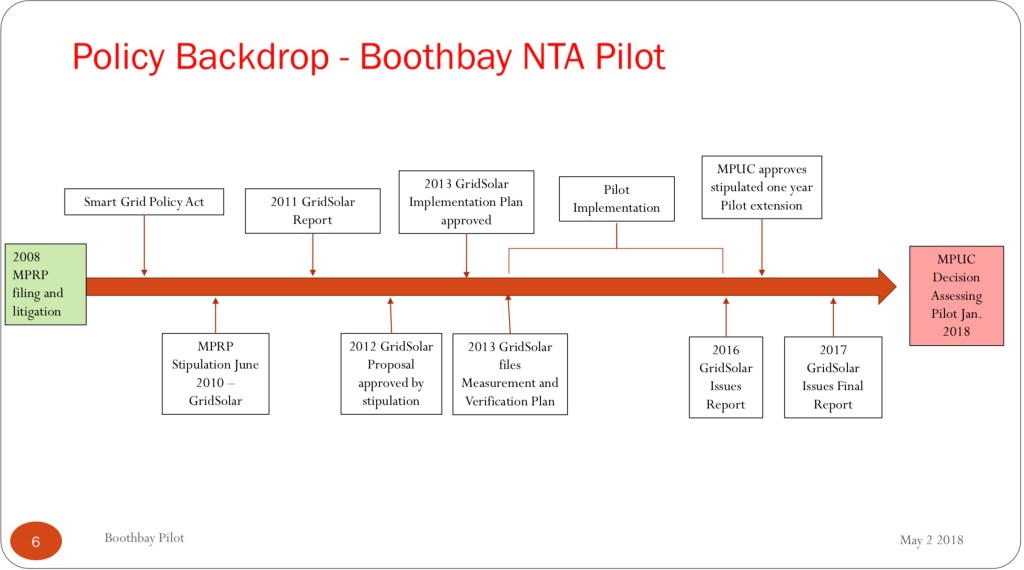
To highlight what a re-development of our grid could look like, I want to discuss the Boothbay Harbor Non-Transmission Alternative that was undertaken between 2008-2018.

In 2008 CMP submitted a rate case filing with the Maine PUC, proposing a $1.5 billion transmission upgrade for the state involving the refurbishment of 300+ miles of lines. Their goal was to address reliability concerns as the forecasts predicted an increase in peak load conditions. GridSolar petitioned, saying that the projected forecasts were too high and did not warrant CMP’s high-cost solution. The Maine PUC agreed to let GridSolar develop a Non-Transmission Alternative rather than the transmission lines.

The initial approval was subject to the project being affordable, meeting forecasted reliability requirements, whether the NTA’s could be capable of responding to grid reliability issues, and if the project was scalable to other Maine communities. As we will come to find, it not only met these requirements but blew them right out of the lobster pot!

For starters, the initial cost of the new transmission was proposed by CMP at $18 million for the region, the pilot presented by GridSolar would cost only $1.85 million for a portfolio of investments designed to both lower demand on the distribution lines as well as provide elastic demand when a fast response is needed. The difference in price alone highlights the main difference between the two grid models. Transmission is expensive and in constant need of updating based on changing demand as well as aging equipment. NTA’s are capable of meeting the same increases in demand, but at a much lower price because the focus is to create a more energy-resilient community rather than try to bring in electricity from elsewhere in the state.

The structure of the grid wasn’t the only reason for costs being lower. This efficiency was similarly achieved thanks to GridSolar managing certain aspects of the NTA’s as well as the importance given to creating a comprehensive system, rather than focus on one or two solutions. These included a consolidated effort between local businesses and GridSolar to replace aging equipment with newer, more energy-efficient models. One such example is the adoption of the Ice Bear AC Systems, which can be turned off during peak electricity hours, meaning that the unit only draws electricity when it is the cheapest and most abundant. GridSolar oversaw the control for these systems while CMP provided the data on peak demand. This type of partnership allowed for hands-on community-based management, helping to ensure lower operating costs for all. Another example is the 500 kW diesel generator that provided the flexibility to supplement the other systems during periods of slower generation. GridSolar used the newly developed network operations center to manage incoming data and determine when this system needed to be in use.

https://pubs.naruc.org/pub/68538416-FD2C-6345-2297-52285E5106BC

Overall the project was a success both fiscally and based on the criteria put in place earlier. It was officially scrapped in 2018 due to the region failing to develop the need for the change in demand. However, this I feel highlights two very important takeaways from these types of investments. Firstly, they allow you to protect yourself from stranded costs or the act of investing money into an area that fails to develop as forecasted. Secondly, they will enable you to adapt your infrastructure to local demand. For instance, if we were to look at a similar community such as Harpswell, ME, you can see how an NTA in addition to already existing infrastructure could be invaluable to those in the community. As an example, in 2017 Harpswell lost power for several days due to a massive windstorm. Specifically Bailey Island, which had all of the electricity poles crossing the bridge collapsed, was stranded in the dark. If Harpswell was to invest in an NTA, than we could start to address the issue of severe weather events leaving vulnerable citizens in the dark. For instance, the addition of solar and/or battery back-ups help to keep the lights on in those situations where the main infrastructure fails. This would help not only the well-being of those living there, but economically it would make these areas seem less risky for those looking to purchase homes or invest in local business.

In conclusion, whether or not you agree with the consumer option addressed at the beginning of this post, there is an undeniable need for change within our current infrastructure. We pay too much for some of the worst electrical services (based on outages) in the country. We as a people should demand that these cost-saving alternatives be brought to the table rather than investing in the traditional infrastructure. By doing so, not only will we be helping ourselves to live healthier, happier lives, but we could also start to change the way that people view Maine. If we invest in ourselves, more business will be attracted to the state, allowing for more of the mid-income jobs I argued we lacked in the JOLT piece. Only then will we begin to see the Maine economy’s full potential begin to come to light.

JOLT Report – Observations From a Mainiac

If you’re like me, I am sure you were waiting with bated breath for the Job Openings and Labor Turnover report from the Bureau of Labor Statistics. When looking at the overall health of our labor force, I find the JOLT holds significantly more value than the Unemployment Numbers. For instance, this report lets you see the total number of new hires vs. total separations. While unemployment gives similar statistics, it contains fewer categories and less definition. As well, the JOLT allows you to compare these numbers with the total number of job openings. This allows us to determine if a positive report (unemployment going down) is significant enough to satisfy market demand.

The big takeaways from the April report are job openings are surging while separations, and quits explicitly, are continuing at a robust pace. An interesting change in the Beveridge Curve shows that even while Job Openings continue to soar, the unemployment rate holds steady. This implies that while the workforce exists, it is not translating into employment in numbers sufficient enough to match market demand. IE – Businesses are operating below desired capacity. While the reasons for this can be disputed, as put by Tim Duy of SGH Macro Advisors said, and being the core of my argument today, “it appears that labor market frictions not related to unemployment insurance appear to have been increasing. That’s not exactly great news if you are expecting the end of enhanced UI benefits will dramatically ease labor market frictions.”

To highlight this effect on the ground, I wanted to talk about some observations I have made from my home state of Maine. A not-so-quick run down for those that haven’t done the deep dive. Maine may appear on its surface as a tourist-fueled, service-based economy. However, much like its geography, the actual economy is robust and diverse. When broken down by the Real Value Added to GDP (2020 Values), the top three sectors are Finance and Real Estate ($11.49B), Educational and Health Services ($7.53B), and Government Enterprises ($7.49B). When looked at through total employment, the top three are Educational and Health Services (125,100 or 20.5%), Trade, Transportation, and Utilities (116,000 or 19%), and Government (96,100 or 15.7%). This demonstrates how Maine’s workforce is primarily dominated by low to mid-income, transient workers. To see this in more clarity, you can look to Trade, Transportation, and Utilities which makes up 19% of Maine’s total labor force, while only accounting for 8% of its GDP, in contrast with Professional and Business Services which accounts for 11% of Labor Force and 12% of GDP. Another surprising thing to note is that Arts, Entertainment, Recreation, Accommodation, and Food Services represent 9.3% of the Total Labor Force and only 4% of the total GDP.

While the above numbers are for what can be argued as an incredibly irregular year, they still represent one of Maine’s most significant hurdles and one that has been developing since long before the Pandemic. Maine’s economy is fueled by relatively few, while most work for industries that produce (and pay) less. This dichotomy creates vast wealth difference seen clearly, even when looking at just the four towns of my home School District. This type of work also develops into a second subset of issues. Workers feel less of a sentimental connection with their places of employment and home state, translating into less business investment as they continue to find a smaller, less skilled pool of workers to invest in. Even when looking at my class, it is clear to see that, while there are those that stayed in the state and have been successful, the majority of the money earners are those that left broader horizons. Put more simply, Maine lacks real opportunity and attractive workplaces.

A clear example of how this division in labor (and wages) affects even micro-economies is to compare Brunswick and Lewiston. On their surface, the two towns are pretty similar; both boast relative proximity to the labor hub of Portland, both host well-accredited colleges offering jobs and a steady supply of new consumers, and both benefit from a river running through that offers recreational as well as historical significance. However, the actual towns today are so far apart when it comes to quality of life; it begs you to sit down and ask yourself why? The answer is, like most, too complicated to ever give one definitive point. However, as I was discussing above, I would argue that one of the driving forces is how jobs accumulated within the state. While both towns offered robust labor pools, because of a finite amount of skilled labor in our economy, and human nature being that we want to be close to water, the jobs made their way to the town closer to the coast.

This lead to the dichotomy that we see today. While many Brunswick residents work in skilled jobs, Lewiston’s residents continue to work as laborers. As this division has grown, another issue has arisen. Because their economies often support far less capital than the more educated counties, these same laborers often have to travel further to compete for work. It is this dual problem of low capital communities supporting our labor force as well as being forced to travel to areas that represent demand that has contributed to our ever-worsening labor issues. Yes, the Pandemic and closures halted the very fragile system we had built; however, it is too early to say that just because we’re “opening things up” means that these workers will want to return.

Let’s get back to the JOLTS Report for a second. An interesting point to note is that Job Openings have increased to a series high (beginning in December 2000) of 9.3 million or 6.0%, with the most significant increase being in Accommodation and Food Services. This once again highlights an authentic aspect of Maine’s economy, jobs increase in the summer. As we continue to hear from local business owners, those jobs are here, but no one wants them. Now we again need to ask ourselves why?

As I said previously, my argument is that it has less to do with incentives and more with the nature of Maine’s economy. For years local businesses have relied upon the H-1B Visa to supplement their scarce workforce. As young Mainah’s continue to trickle out of state or be pushed into more rural and affordable communities, this pattern only gained momentum among the more capital-rich communities. This trend certainly didn’t just go away after the pandemic. While Maine’s workforce did grow during 2020, a breakdown of sectors once again shows that those that moved into the state are working the high-paying (now remote) jobs and moving to counties like Cumberland. Because of this, I would argue that as we continue to open up after the pandemic, we will experience higher demand for goods and services than we did before. Meaning that the challenge of maintaining a robust workforce will only grow harder.

Now, you may be wondering, “well, what can we do about it?” The easy answer is, “I don’t know.”

As stated at the beginning of this post, and while I have focused specifically on the quality of work in this example, the reasons for this issue have been worsening for over a decade, and to address all of them would require a focused government effort to support the quality, rather than quantity of jobs offered. This can be done in many different ways. I’ll highlight one as I feel this post is getting long.

Promoting quality jobs is easiest done when you focus on changing the nature of business development rather than trying to alter existing structures. A great example of this is how FAME (Finance Authority of Maine) uses its bond-buying program to support the development of new businesses. FAME, for those unfamiliar, offers several services from traditional loan insurance programs, investment tax credits, tax-exempt bond financing programs, as well as being in charge of administering the State’s higher education finance programs. Their vision is to – “Help Lead the creation of good-paying jobs for Maine residents by working at the nexus between economic and workforce development.” Their success shows the importance of attaching the quality of jobs to the mission of finance. By doing so, we can change the work that is being offered, as well as (in some instances) where. For example, in April of 2021, FAME approved $135Million in Bonds to help develop a previously shut down ski resort at Moosehead Lake. The funds will finance part of the total costs in the acquisition, rehabilitation, design, construction, and equipping of the resort. The project is expected to create 380 full and part-time jobs in Piscataquis County, one of the many that, based on the criteria I have laid out here, could use some new local labor opportunities. Not only does this kind of development promote better labor growth, but it also helps to generate tax revenue, allowing for more of this kind of financing in the future if the programs are in place. While we will have to wait a few years before we deem this project a success, I personally believe in this type of consumer-based growth.

It is up to us to decide how the economic forces we have created over centuries work for us. Increasing GDP has its benefits and should not be overlooked, but at the same time, we should be focusing on the real-life of the people on the ground. Money is far from the only deciding factor in individual lives. To solve our current problems, we need to think critically about what makes a worker want to work and what we can do as a state to promote a healthy market for all.

Who Am I and Why Do I Care?

Hello to Those That Find Their Way Here:

My name is Tim Prindall. I figure I should start by telling you a little bit about me. I am currently employed as a full-time Associate Broker at the Harpswell Realty Group up in Maine, as well as working part-time at Starbucks for health insurance purposes. But that is not where this story begins; as a young boy, barely 14, I witnessed my father lose what was supposed to be a stable job, close to home for the first time in years, all because of a financial crisis I yet had the ability to understand. Approaching high school and with an older brother going into college, I could feel the tension as my father started what would prove to be a desperate battle to find a new job, crossing state borders and splitting our family apart.

Throughout this tumultuous time, my coming-of-age story was written. Witnessing families in mental peril, seeing people lose their homes, and being subjected to a prolonged and dismal recovery. While I was still young, it was evident from the news that the world was dark and the light was still far away…

Eventually, stability was found, and after being successful enough in High School, I started to look at College. I settled on Eckerd College in St. Petersburg, Florida. An excellent school that I recommend to everyone; unfortunately, due to financial constraints, I had to leave after only two years. Thankfully while there, I attended a course in Environmental Economics that has influenced me for the rest of my life. Understanding how the resources around us can be valued in ways other than money (and learning how to express these values in dollar teams) helped change the way I look at the world around me. To this day, I challenge myself when I begin to look at commodities as only that; many products come with experiences and memories (positive externalities) that cannot be overlooked. However, I will talk more about the economics forming the basis of my beliefs in another post.

From Eckerd, I moved on to my State College, University of Maine Orono, which proved to be an unhealthy environment for my learning. After only one year, I switched to the University of Southern Maine’s Online Schooling. Still, due to financial constraints, I was taking only one course at a time, paying it off by working at LL Bean and local restaurants. During this time, I was offered the position as an Administrative Assistant (fancy title for receptionist) at a local Real Estate Agency, allowing me the opportunity to learn the beginnings of what would later become my career.

After working in Real Estate for a few years and with a new desire to pursue my love for economics, philosophy, and policy, I began looking at returning to school and finally finishing my bachelor’s degree. To make this more affordable (as well as secure health insurance for myself), I got a job at Starbucks five days a week for five hours. As these changes began to occur in my life, I found myself in need of more flexible hours, encouraging me to move on from the Administrative side of Real Estate and onto Sales. Changing agencies to the one I am still working with to this day.

This catches us up to the present day; from here, there is almost no way of knowing where I will go. What I hope to convey is, throughout this story lies one underlying constant, my desire to understand why our systems had failed us and what we can do to channel those resources into more productive means. This blog will be an accumulation of years of reading, as well as my take on what it means in consideration of current political, social, and economic events. While I lack any formal accreditation, I hope that it helps you explore how you see the world around you and maybe even teach you a thing or two along the way.

My Economic Beliefs – The Basics

After living through the Economic Crisis of 2008, as well as the subsequent shocks we have received, my underlying belief about economics is that its powers are utilized for the wrong idea of good. I mean that our current economic beliefs dictate that the dollar is the most essential and desired product of our time. Even leisure is seen as merely the value of hours spent not working more valuable than those spent working. While this view does help explain some behaviors within our capitalistic economy, I fear it is too shallow to truly understand (and manage) the full power of our economy. From this underlying belief, I have developed my economic philosophy.

Keynesian~ish

To subscribe to a school of economics is to put a label on your beliefs. This clouds your view towards any economic theory presented to you, in that you then must evaluate it under your pre-determined lens. Because of this, I hesitate to label myself, though if I have to, I would say I am Keynesian…. Ish.

You see, based on my everyday observations, I cannot inherently agree with classical theorists or those that tote a Laisse-Faires economy. While their belief in utility maximization does help to explain how people act in a capitalist economy, it lacks the depth needed to understand WHY these people are working this way. Because of this, it leaves holes that lead to issues such as 40% of United States citizens being unable to cover a $400 unexpected bill. Why, if people are determined to maximize their income (as neo-classical economists assume), would anyone let themselves fall into financial peril?

Because of this belief, as well as my understanding of how “free markets” created the 2008 crisis, I began to read more about Keynesian economics. I found myself agreeing with many of their takeaways. For instance, as many notable Keynesian economists have written, Aggregate Demand Theory helps explain many of the market effects we see during recessions much more efficiently than the notion that lower wages lead to more employment. As well, the belief that an economy will always work towards optimization of labor (full employment) is frankly ignorant to real life.

However, I can’t entirely agree with every aspect of this philosophy. For instance, the belief that we can manipulate Aggregate (or Consumer) Demand is, in my mind, foolish. There are many reasons for people consuming products, and many have nothing to do with finances. Instead of focusing on this aspect, I see the real manipulator being our investment in hard goods and services. Products that will not only benefit life in the short term but continue to persevere for years to come. When you look around at the technologies that have most shaped our current society (the internet, GPS, telecommunications), you see how by developing an economy based on improving life quality, you can achieve a much more significant impact than just trying to put money into their hands.

Environmental Economics – How It Changed My Life

While environmental economics is far from a political philosophy, the way it teaches you to perceive the living world is, I think, invaluable towards the way we conduct ourselves as people. From the teachings of externalities as a focus in a business decision making to the understanding of resources value vs. utility, the school allows you to make more informed decisions that benefit not only yourself, but those you do with business with as well.

When I enrolled in my first undergraduate level EE course, I was unsure of what to expect. Reading the course description, I figured I would be learning about how businesses evaluate the value of natural resource stocks (such as oil supply and when to drill or forest management strategies). Because of this, I was blown away when I began to read more about what the field does.

To give an understanding of the work, as well as the significance that it holds, I want to talk about the first Professor I had on the subject, Jeff Felardo. Still, at Eckerd College, Professor Felardo was the first to demonstrate how his work not only influenced how business is done but also the real impact that it can have on humanity. Focusing mainly on Asian countries, I was enthralled as he would tell me about visiting Thailand to help local tribes determine the financial value of their forests (local tribes retained rights on how best to manage their land). What I thought would be a subject on timber costs wound up evolving into a discussion on how to value environmental tourism and use this valuation to contrast the one-time value distribution of harvesting. This outlook on life, not just short-term profits but long-term utility governing our life choices, is the underpinning to many of my beliefs. While oftentimes real life can be very different from projections, I still believe that the only way to create a sustainable economy is to have a mission or goal in mind.

Those That Influence Me – Economic Hero’s of the 21’st Century

To help me better understand how to adapt this economic philosophy, or even if it was feasible, I began to read more from the new wave of European Economists that have surged in the past decade. While few are household names, I truly believe that they will all have a significant influence over how our world progresses, and because of this I make an effort to digest as much of their work as possible.

Mariana Mazzucato – Probably number #1 on my list is Mariana Mazzucato. A Professor in the Economics of Innovation and Public Value at University College London and founding director of the UCL Institute for Innovation & Public Purpose. Her work on books such as Mission Economy, The Value of Everything, and The Entrepreneurial State has redefined how I look at Government spending. Her argument that while producing value is and what should be important to our economy, it is the type of value we are creating that we should be critical of helps to define much of my policy beliefs.

Kazimierz Laski and Michal Kalecki – These two are slightly less modern though still hold great importance in modern economic thought. While most of my teaching in economics has been done by myself, I have challenged myself to not only read non-fiction or autobiographies. To better round out my understanding of economic policies, I purchased a textbook by Kazimierz Laski, adapting the work of Michal Kalecki’s Aggregate Demand Theory. While I have never been strong in math, I found Kazimierz’s style to be easy to digest, and the teachings from this book shape a lot of the more critical and mathematical aspects of my philosophy. However, I can not inherently agree with models based on falsifiable assumptions, though I do believe understanding models allows us to understand real-life systems and outcomes better; therefore, I do think we must start from some mathematical basis.

Rutger Bregman – While economics is often referred to as the dismal science. It is essential to remind ourselves about the very real and human outcomes that this broad school influences. Rutger Bregman’s work is perfect for this. I have read two of his books, both of which have had a profound impact on how I look at the world around me. Humankind helps to highlight the beautiful aspects of humanity, focusing on the parts of us that have created a homogenous, global society, and his book Utopia for Realists that highlights which of these areas that we are currently falling behind in and what we can do to fix it. His work holds a vast amount of importance, especially in a day and age when the human experience is becoming more of a statistics equation rather than a fulfilling life.

Stephany Kelton – I’m sure you’ve all read about Modern Monetary Theory in some form or another. In a world that hovers at the zero lower bound, it is hard to avoid the subject. The problem, at least for me, is that because the school is new, there is little consolidated thought/literature to help guide those looking to learn more about it. Stephany Kelton helped to fill this hole with her book The Deficit Myth. Not only does this book help to highlight the importance of debt in our society, but it also helps to define what this debt is. Especially for someone whose coming of age story comes during a couple of decade period of mind-bending economic events, this book helps explain the problems that Classical Theory (and even Keynesian) fail to clarify.

Richard Wolff – Probably the largest pessimist on this list, Professor Wolff is forever the critic of my wildest daydreams. Through his show Ask Prof Wolff he helps to analyze much of the real-time data that too often gets overlooked. A self-proclaimed socialist, Professor Wolff brings to the table an economic philosophy critical of both business and government, offering viewpoints that are often missed in everyday discussion. I recommend his shows to anyone looking to challenge the way they perceive economics.

And Many More – While the above mentioned are the core of my economic readings. There are numerous financial podcasts, newsletters, and email services that I think are irreplaceable in current society. The amount of information on this subject can not be processed, let alone read, by one individual. It is imperative to listen to as many economists as possible, intending to cover diverse beliefs. In my mind, this is the only way that we can start to come to an understanding of how our world really works.