Maine has always been a unique state. Its population is small and spread out over a swath of undeveloped land. From the remote fishing villages along Downeast Maine’s coast to the unorganized townships to the north, much of Maine is fueled by small micro-economies rather than the macroeconomy as a whole. There is one area in which we as Mainah’s share the load, though, the energy grid. My argument in today’s post highlights how our lack of community focus in this one field has allowed companies like Central Maine Power to take advantage of our citizens, as well as how it fueled Maine’s exorbitantly high electricity costs.
For starters, let’s discuss the Clean Energy Connect. For the past three years, Hydro-Quebec and CMP have petitioned the state’s legislators to push through a “clean energy corridor” to supply Massachusetts with hydro-power produced in Canada. When the project was initially proposed in 2018, Massachusetts selected the Northern Pass Project, presented by Eversource. This project would have had the line run 192 miles across New Hampshire and Massachusetts, with a 60-mile portion of the line to be buried to protect areas of the White Mountain National Forest. The final project proposed by CMP is for 145 miles and 53 miles of new cutting to develop a line from Beattie Township to a connection into the New England Electric grid in Lewiston. The costs of the development (~$950Million) are to be paid by Massachusetts.
When proposed, the Eversource deal offered New Hampshire $210 million in funds to help tourism, economic development, and habitat restoration projects. For comparison, the CMP deal offered to Maine (after negotiation from Governor Mills) $258 million in a similar package. While these may seem similar on their face, it is important to note that the additional funds to Maine are to be distributed over the next couple of decades. With Maine receiving it’s first round of payments amounting to a measly $5.8 million, this May, it’s clear that the the funds will need to be carefully managed as over such a long timeline allocation mistakes are bound to happen.
While the two deals are similar, it is this similarity that I feel points to the significant issues within our current energy grid. For starters, if CMP was able to meet the $200 million that Eversource offered initially, why was their first offer for just $50 million? The answer is simple; the deal is good at either number. Both of these companies could make Billions with these contracts, meaning that a couple hundred million is chump change for them. All while these funds mean serious business for these states. If there is this much profit to be made by business owners that aren’t even US citizens, why aren’t we trying to capitalize on this market ourselves?
There are many different ways we could do this. As an example, I’d point out the recent legislation put forth in the attempt to create a Consumer-Owned Utility for the state of Maine. While I am personally a fan of this proposal, it is not the leading solution I want to highlight with this post. For me, the most significant issue we face is an antiquated grid that was made for electricity production nearly a hundred years ago. Our current capabilities are leaps and bounds ahead of anything we have seen in the past, finally offering us the ability to alter an incredibly inefficient system. Especially when you start to look at states like Maine, does this need for a new energy grid start to become apparent. We are a spread-out state; as I stated at the beginning of the post, Maine’s population is often found in tiny micro-communities capable of sustaining themselves. This type of population distribution creates a problem that more developed states do not have to overcome; if everyone lives everywhere, it doesn’t matter where the energy is produced. There’s always a customer close by you can cheaply get it too. As well, just like the UK and teapots creating energy spikes in the afternoon, Maine experiences an incredibly seasonal amount of electricity demand, spiking with the population in the summer months.
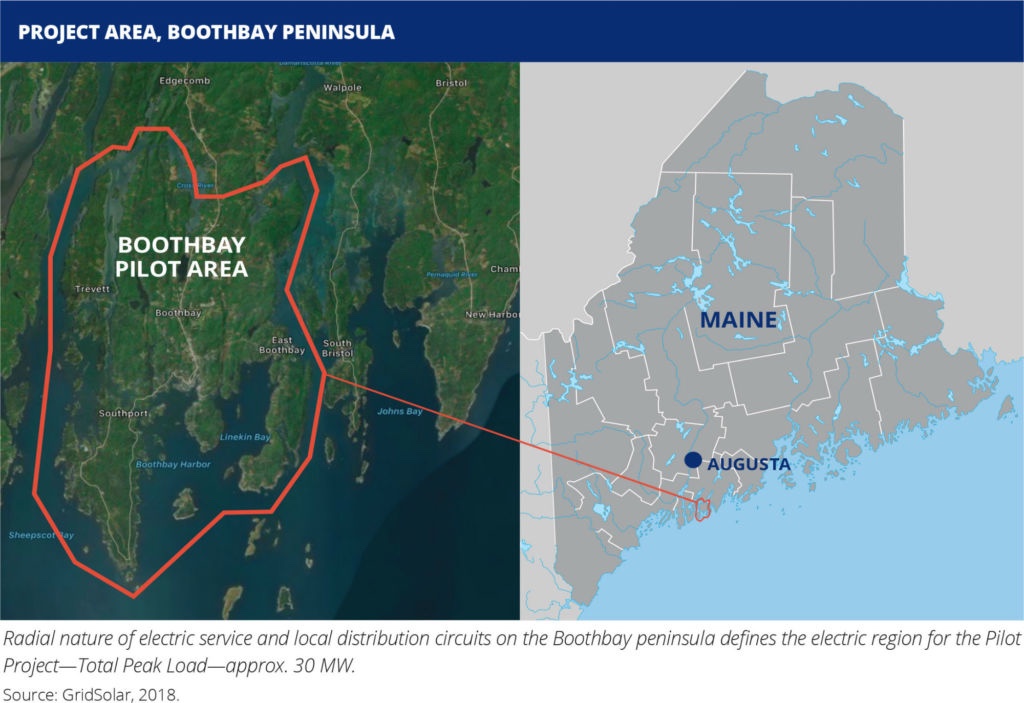
To highlight what a re-development of our grid could look like, I want to discuss the Boothbay Harbor Non-Transmission Alternative that was undertaken between 2008-2018.
In 2008 CMP submitted a rate case filing with the Maine PUC, proposing a $1.5 billion transmission upgrade for the state involving the refurbishment of 300+ miles of lines. Their goal was to address reliability concerns as the forecasts predicted an increase in peak load conditions. GridSolar petitioned, saying that the projected forecasts were too high and did not warrant CMP’s high-cost solution. The Maine PUC agreed to let GridSolar develop a Non-Transmission Alternative rather than the transmission lines.
The initial approval was subject to the project being affordable, meeting forecasted reliability requirements, whether the NTA’s could be capable of responding to grid reliability issues, and if the project was scalable to other Maine communities. As we will come to find, it not only met these requirements but blew them right out of the lobster pot!
For starters, the initial cost of the new transmission was proposed by CMP at $18 million for the region, the pilot presented by GridSolar would cost only $1.85 million for a portfolio of investments designed to both lower demand on the distribution lines as well as provide elastic demand when a fast response is needed. The difference in price alone highlights the main difference between the two grid models. Transmission is expensive and in constant need of updating based on changing demand as well as aging equipment. NTA’s are capable of meeting the same increases in demand, but at a much lower price because the focus is to create a more energy-resilient community rather than try to bring in electricity from elsewhere in the state.
The structure of the grid wasn’t the only reason for costs being lower. This efficiency was similarly achieved thanks to GridSolar managing certain aspects of the NTA’s as well as the importance given to creating a comprehensive system, rather than focus on one or two solutions. These included a consolidated effort between local businesses and GridSolar to replace aging equipment with newer, more energy-efficient models. One such example is the adoption of the Ice Bear AC Systems, which can be turned off during peak electricity hours, meaning that the unit only draws electricity when it is the cheapest and most abundant. GridSolar oversaw the control for these systems while CMP provided the data on peak demand. This type of partnership allowed for hands-on community-based management, helping to ensure lower operating costs for all. Another example is the 500 kW diesel generator that provided the flexibility to supplement the other systems during periods of slower generation. GridSolar used the newly developed network operations center to manage incoming data and determine when this system needed to be in use.
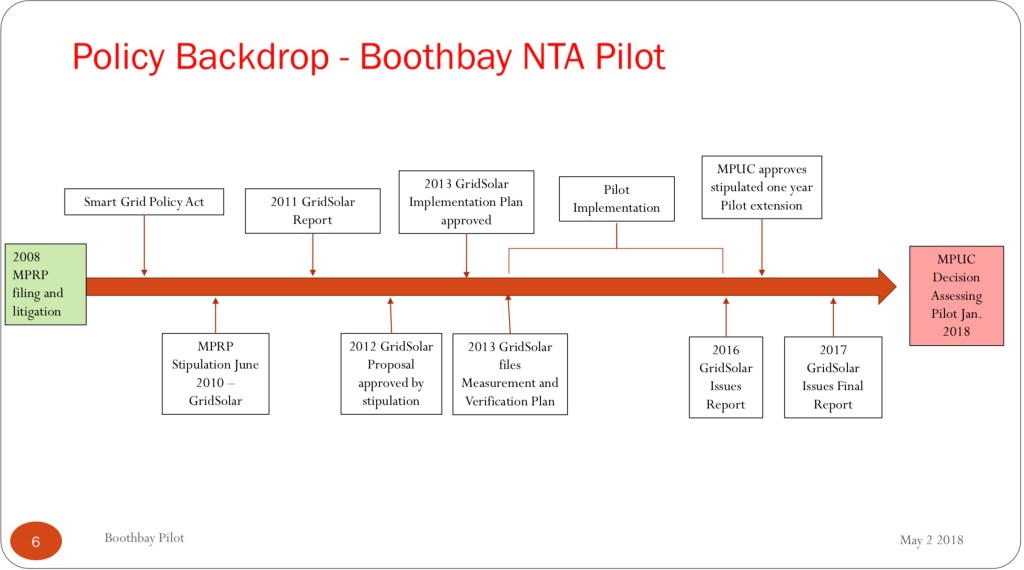
Overall the project was a success both fiscally and based on the criteria put in place earlier. It was officially scrapped in 2018 due to the region failing to develop the need for the change in demand. However, this I feel highlights two very important takeaways from these types of investments. Firstly, they allow you to protect yourself from stranded costs or the act of investing money into an area that fails to develop as forecasted. Secondly, they will enable you to adapt your infrastructure to local demand. For instance, if we were to look at a similar community such as Harpswell, ME, you can see how an NTA in addition to already existing infrastructure could be invaluable to those in the community. As an example, in 2017 Harpswell lost power for several days due to a massive windstorm. Specifically Bailey Island, which had all of the electricity poles crossing the bridge collapsed, was stranded in the dark. If Harpswell was to invest in an NTA, than we could start to address the issue of severe weather events leaving vulnerable citizens in the dark. For instance, the addition of solar and/or battery back-ups help to keep the lights on in those situations where the main infrastructure fails. This would help not only the well-being of those living there, but economically it would make these areas seem less risky for those looking to purchase homes or invest in local business.
In conclusion, whether or not you agree with the consumer option addressed at the beginning of this post, there is an undeniable need for change within our current infrastructure. We pay too much for some of the worst electrical services (based on outages) in the country. We as a people should demand that these cost-saving alternatives be brought to the table rather than investing in the traditional infrastructure. By doing so, not only will we be helping ourselves to live healthier, happier lives, but we could also start to change the way that people view Maine. If we invest in ourselves, more business will be attracted to the state, allowing for more of the mid-income jobs I argued we lacked in the JOLT piece. Only then will we begin to see the Maine economy’s full potential begin to come to light.

 My Maine Musings